
Define the approval question
Gravity belt thickening and belt-press dewatering are related but different purchasing duties. For a thickener, the acceptance record should focus on concentration, solids retention and useful output to the next process rather than borrowing a final-cake target from a press.
Identify the product code, representative sludge and operating constraint before requesting a commercial commitment.
State the downstream requirement
Identify incoming sludge, required thickened-feed range, hydraulic and solids loading, and the destination of filtrate and thickened solids. Record belt and distribution conditions. The press-zone guide supplies related observations but does not make the two duties identical.
Agree the output measurement and sampling interval before comparing suppliers so an attractive drainage observation does not become an undefined approval.
Screen conditioning at realistic loading
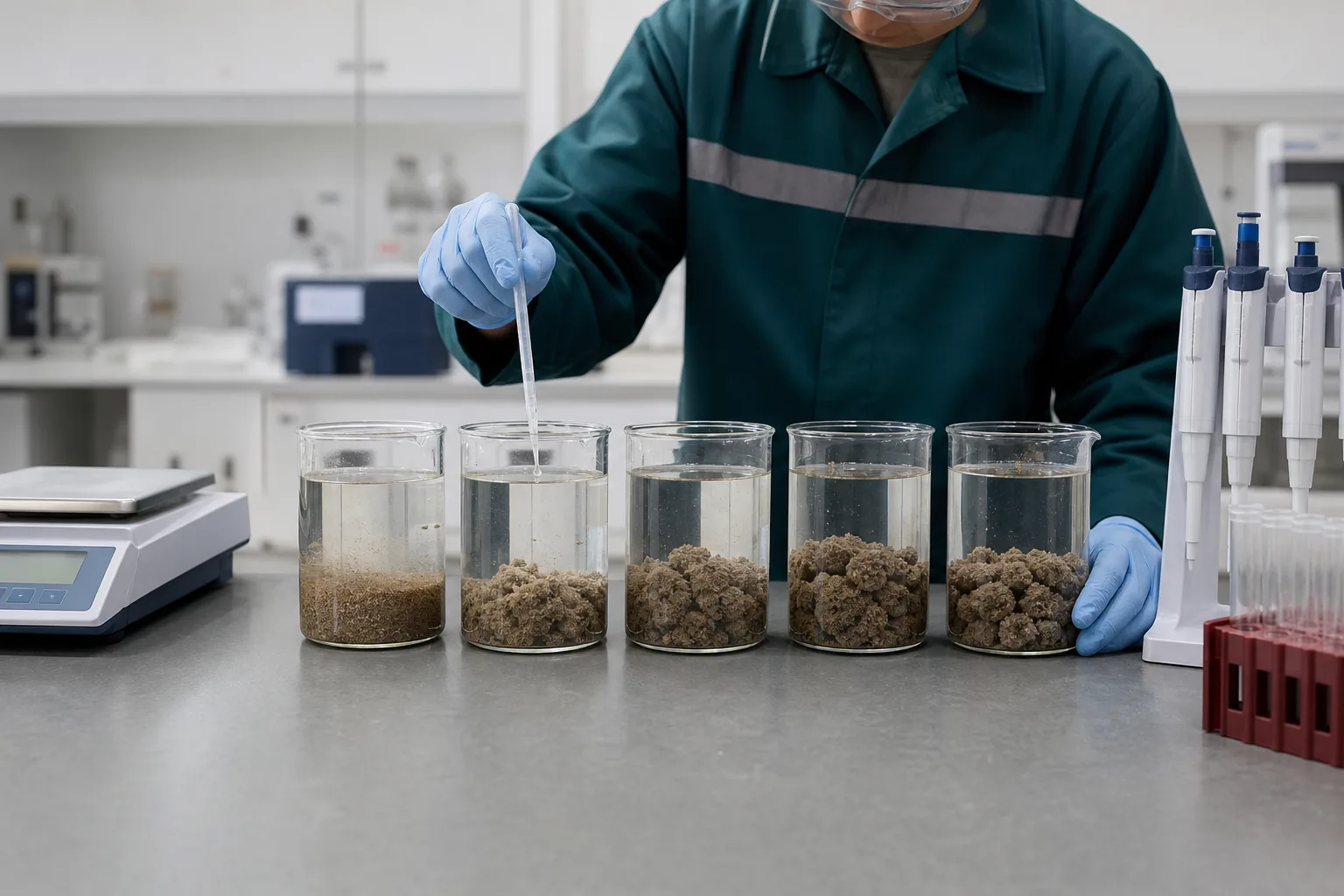
Prepare incumbent and candidates consistently and compare dose ranges against representative feed. Measure filtrate solids and drainage, and observe distribution across the belt. Retain both poorly conditioned and excessive-dose points to define the useful operating window.
Confirm actual solution delivery. A low-dose requirement that falls outside stable pump turndown is an equipment limitation, not proof that the sample works automatically at full scale.
Approve the complete process handoff
Measure thickened-sludge concentration, capture, throughput and operating stability on the machine. Include the downstream process requirements the plant has specified, without inventing a general compatibility guarantee.
Link accepted grade and active consumption to the actual thickening duty. Do not use a final-dewatering chemical budget unchanged when the purchased function is only upstream thickening.
Challenge a favorable comparison
A faster draining belt may produce uneven solids concentration or unacceptable fines return. Keep those outputs with the apparent benefit; a purchase should not shift an unmeasured load into the next process merely to report lower polymer use.
Record the unresolved boundary with the trial result. An expected operating benefit is not a measured saving or an unrestricted product guarantee.
Keep the acceptance record
| Buying check | Evidence | Acceptance limit |
|---|---|---|
| Duty | Thickened-feed and filtrate criteria | Not a final-cake target |
| Loading | Representative flow and solids | Screen represents duty |
| Handoff | Capture and downstream acceptance | Whole route considered |
Retain sample identity, measured preparation conditions and synchronized feed and outlet results. Use the record to distinguish an agreed product change from a change in sludge or equipment.
Prepare the supplier brief
Send thickener configuration, feed and target solids, flow, return route, current polymer and dose, and downstream restrictions. Ask for a sample set intended for thickening with a clearly stated acceptance plan.
Send the evidence through the cationic emulsion sample and RFQ form. Confirm the offered code, availability, packaging and document scope with Gongyi Xinqi Polymer Co., Ltd. before ordering.