
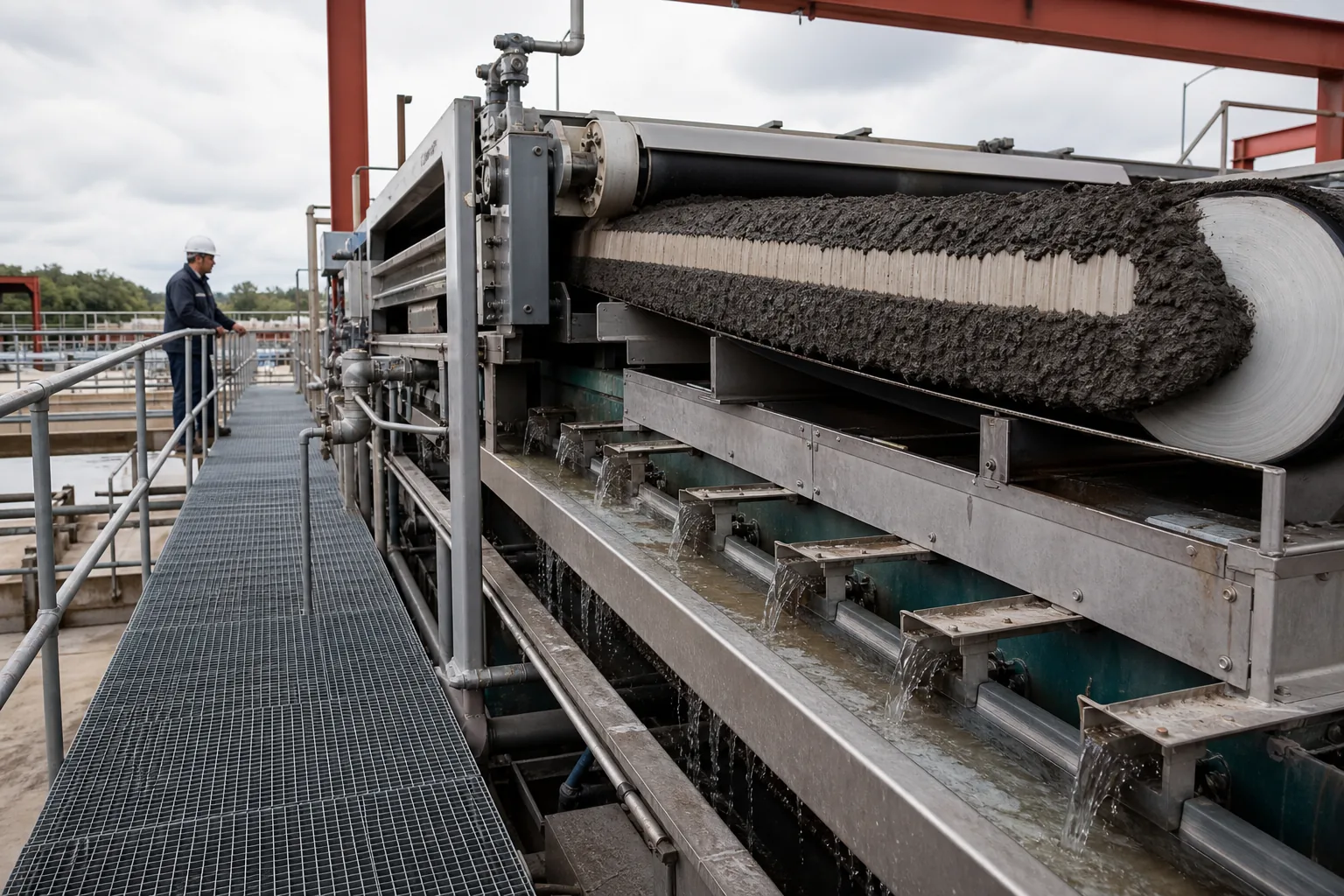
Read each press zone
Observe the conditioning point, gravity drainage, wedge, pressure zones, cake discharge and belt wash separately. The location of a symptom narrows the likely cause.
Record feed solids, belt speed, tension, loading and wash condition before changing polymer. A blocked nozzle or uneven feed distribution cannot be corrected reliably with extra dose.
Recognize underconditioning
Slow gravity drainage, weak floc, solids migration and dirty filtrate can indicate insufficient active dose, unsuitable charge profile or incomplete activation.
Check make-down and calibration first, then increase dose in measured steps. If response remains weak across a sensible curve, screen an adjacent charge profile.
Recognize overconditioning
Sticky sludge, cloth blinding, poor cake release or gelatinous material can indicate excess polymer. Very rapid local drainage with uneven distribution can also destabilize press operation.
Reduce active dose methodically and observe a full press residence time. Do not compensate for overdose by changing several mechanical settings simultaneously.
Check contact and shear
Too little contact can leave unconditioned zones; too much turbulence can break developing floc. Compare available injection points and keep the selected location in the operating record.
Prepared-solution concentration changes mixing and pump range. Verify it alongside dose rather than treating dilution water as irrelevant.
Close the diagnostic loop
Measure filtrate solids, capture, cake solids, throughput, wash demand and dose before and after each controlled change. Keep photographs as supporting evidence, not the only evidence.
The paper sludge application file shows how fiber and filler composition should remain visible during press trials.
Separate chemistry from cloth condition
Inspect belt permeability, seam condition, spray coverage and drainage trays on a planned schedule. A blinded or damaged belt changes the response to every polymer and can cause operators to increase dose without solving the restriction.
Compare performance immediately after verified cleaning with the pre-cleaning baseline. If drainage recovers without a chemistry change, return dose to the previously established window before beginning a new product screen.
Set operating limits and response steps
Define normal ranges for feed solids, gravity-zone drainage, filtrate quality, cake release and active dose. Pair each deviation with a short response sequence: verify instrumentation, inspect wash and feed distribution, check make-down, then adjust dose or profile.
This order reduces uncontrolled trial-and-error. It also produces consistent information for technical sales when the plant needs a different charge range or a fresh sample comparison.
Document recurring failure patterns
Use a short event record for each upset: time, feed condition, polymer lot, active dose, preparation readings, press settings, visible symptom and corrective action. Attach filtrate or cake measurements where available.
Review repeated events by category rather than treating each shift as an isolated problem. Patterns can reveal a solids-loading threshold, cleaning interval, troublesome sludge blend or make-down limitation that a simple dose increase would continue to hide.