
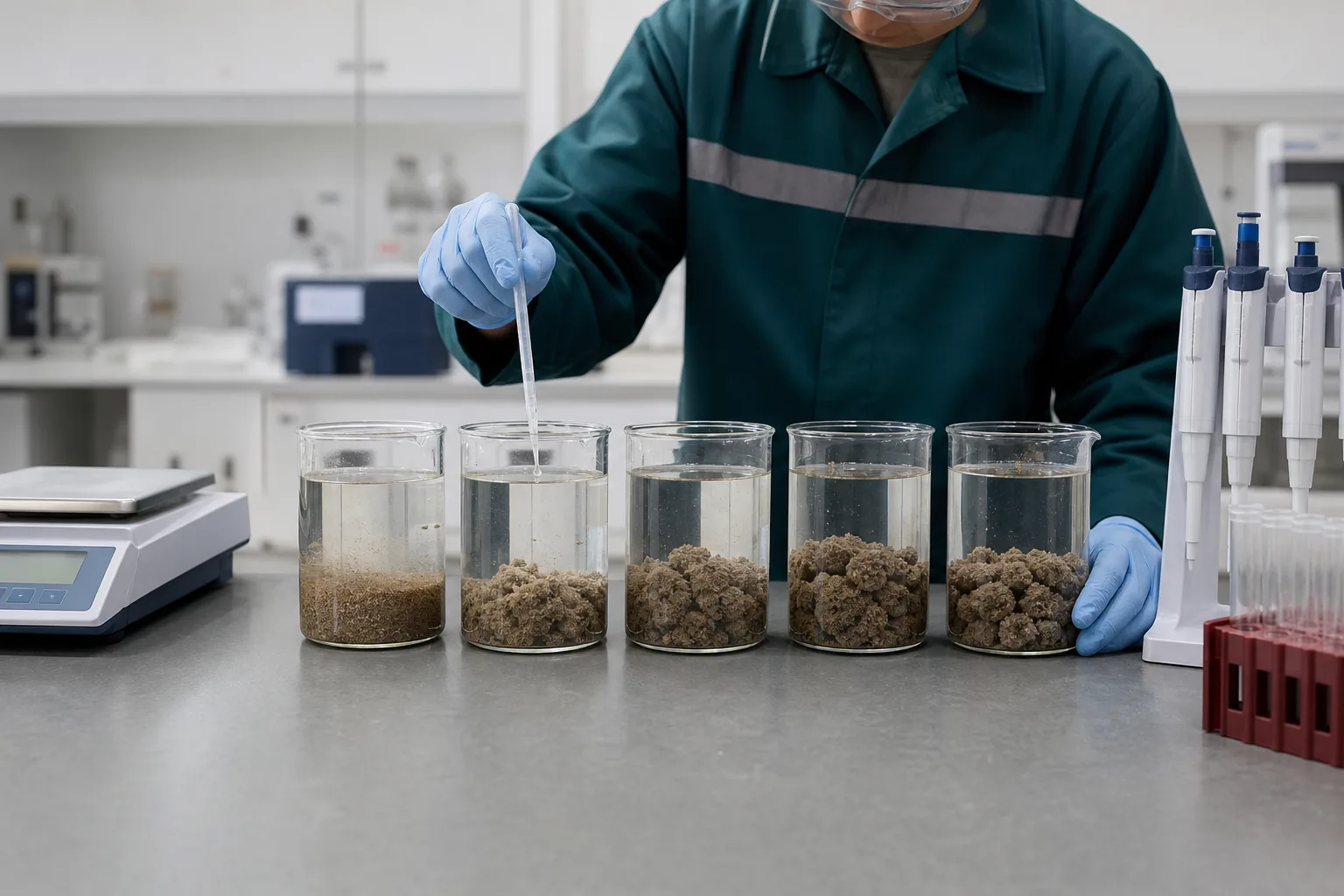
Define the trial window
Medium charge is a screening position, not a universal answer. Mixed primary and biological solids may respond when charge neutralization and polymer bridging are both needed without driving the system into a sticky overdosed condition.
Compare candidates at equal active-polymer dose. Record feed total solids, pH, conductivity, upstream coagulant and sludge age so a favorable result can be repeated rather than attributed to a product name alone.
Read the separation endpoint
For a belt press, observe gravity drainage, belt release, wash-water demand and filtrate solids. For a centrifuge, record centrate clarity, cake solids, torque, differential speed and polymer consumption per dry tonne.
A candidate that creates an impressive beaker floc can still fail under equipment shear. Advance it only after the active-dose basis and full equipment endpoint agree.
Specify the operating envelope
Record the acceptable neat-product temperature, water quality, dilution ratio, aging time and injection location. These conditions become part of the grade record because incomplete inversion can make an appropriate polymer appear weak.
Request a sample set spanning adjacent charge profiles when feed composition changes. The quotation should identify active content, package, storage guidance, COA/SDS availability and destination.