
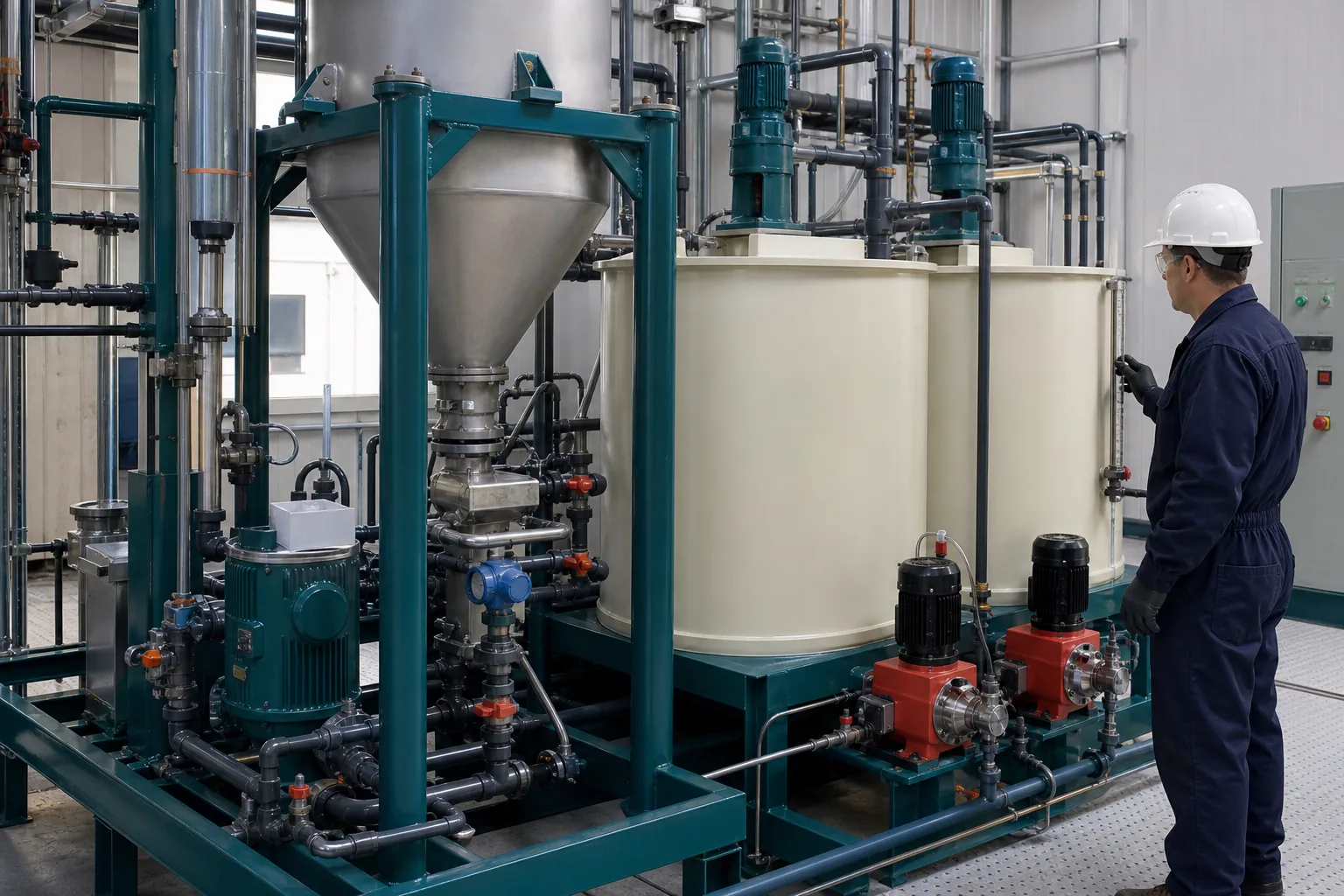
Map the liquid path
Trace the system from storage tote through suction line, neat pump, water contactor, mixer, aging volume, solution pump and injection point. Record design and actual flows at normal and turndown conditions.
A stable path makes chemistry trials comparable. Air leaks, blocked strainers, pulsating pumps or drifting water flow can create apparent product variation.
Calibrate neat and water flow
Verify pump output gravimetrically or volumetrically across the operating range. Check the water meter independently and calculate solution concentration from measured flows rather than dial positions.
Normalize polymer comparison to active mass. Two emulsions with different active content cannot be compared fairly by equal neat litres.
Create controlled first contact
The initial water-emulsion contact should disperse droplets without prolonged destructive shear on developing polymer chains. Follow the product-specific sequence and ensure water conditions are within the supplier's guidance.
Inspect for streaks, globules, deposits or phase-rich material. These observations help separate emulsion transfer problems from insufficient mixing.
Allow useful maturation
Aging volume should match actual flow and prevent short-circuiting. Compare solution response at defined residence times instead of assuming a tank name guarantees maturation.
Keep the prepared solution moving as required without excessive recirculation. Establish a maximum use time from supplier guidance and plant evidence.
Commission at the separator
Move from water-only checks to sludge at conservative dose, then build a dose curve. Adjust one variable at a time: solution strength, dose, injection point or equipment setting.
Preserve the final recipe with the application record. A reproducible make-down method is part of the purchased result.
Inspect storage and transfer conditions
Confirm the tote or drum is identified, within the supplier's storage window and protected from contamination. Check suction hoses, valves, strainers and seals for incompatible residues or water entry before connecting a new lot.
Measure neat-product temperature when viscosity or pump output changes. A transfer problem can create an erratic feed even when the pump command is stable, so receiving and storage observations belong in the make-down log.
Troubleshoot weak or unstable response
If every product suddenly appears weak, first verify sludge flow, solids, neat calibration, water flow and injection. Inspect prepared solution for deposits, globules or inconsistent texture and compare a fresh hand-prepared control where practical.
If only one product or lot behaves differently under the same controlled method, retain samples and contact the supplier with the full record. This sequence prevents mechanical faults from being mistaken for chemistry and preserves evidence for a batch review.
Plan cleaning, shutdown and standby
Define how the make-down unit, solution lines and injection point are flushed without sending an uncontrolled polymer slug to the process. Follow equipment and product guidance for shutdown duration, drain-down and restart sequence.
After extended standby, inspect stored emulsion, verify pump prime and recheck measured water and neat flow before returning to automatic control. A controlled restart prevents aged solution or trapped concentrate from distorting the first dewatering results.