
Product form and function
Cationic polyacrylamide emulsion is a concentrated liquid delivery form for positively charged, water-soluble polymer. The polymer is dispersed in an inverse-emulsion system and must be contacted with dilution water under controlled mixing so the active chains become available.
Positive charge can destabilize negatively charged organic solids, while long chains can bridge particles into flocs. The useful balance depends on sludge composition, charge demand, molecular profile, dose, preparation and downstream shear.
Why form is not the grade
The word emulsion describes handling form; it does not define charge density, molecular behavior or application fit. Two cationic emulsions can behave differently on the same sludge, and the same product can change response when feed chemistry moves.
Build the grade decision from a controlled sample set. Compare adjacent charge profiles at equal active dose and keep the make-down method constant.
Activation is part of performance
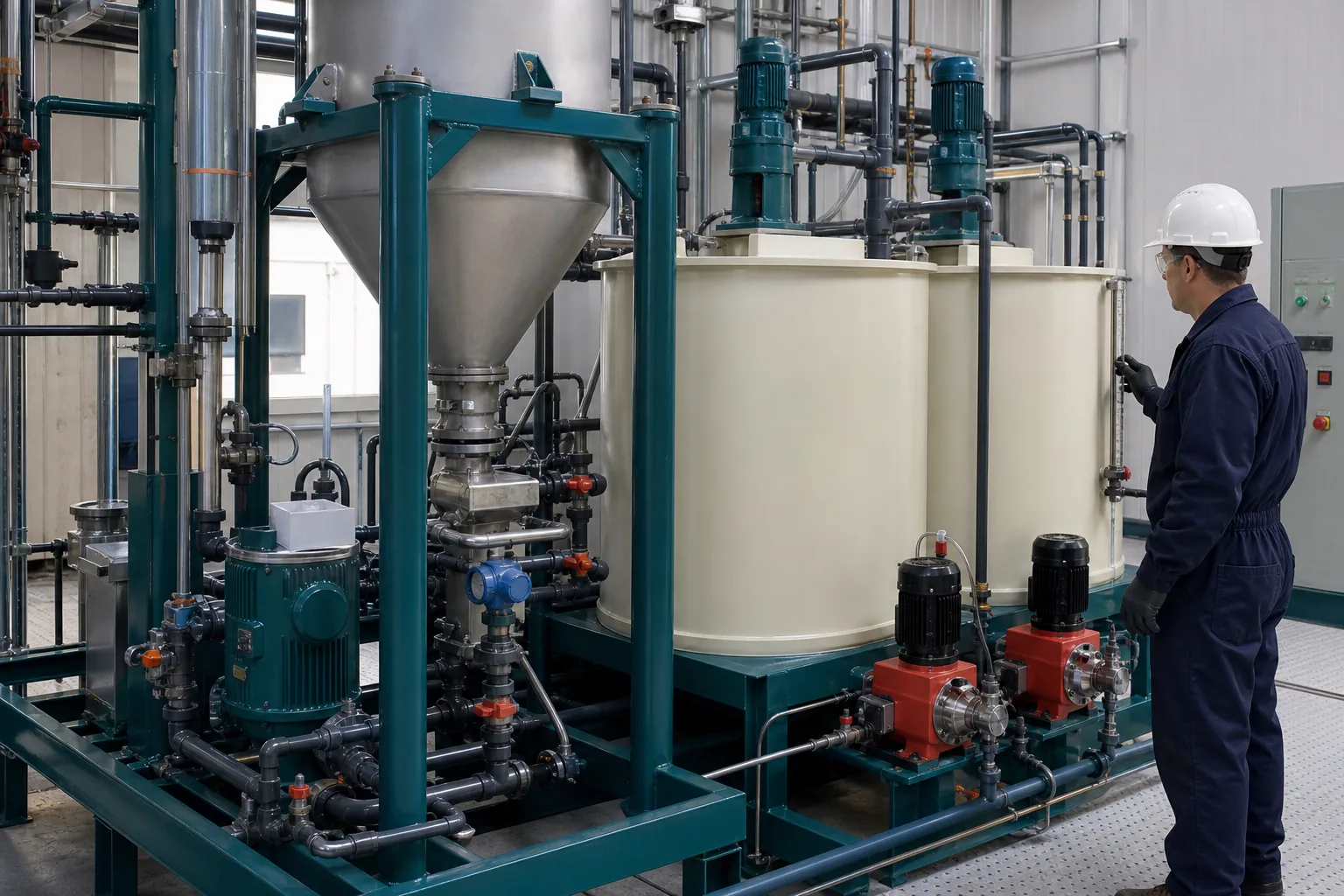
Neat emulsion should not be judged as if it were a ready-to-dose polymer solution. Water flow, mixing energy, temperature, hardness, initial dispersion and aging volume influence how completely the polymer becomes available.
Inspect calibration and flow before blaming chemistry. Fish-eyes, oil-rich streaks, unstable solution viscosity or weak floc across every candidate may indicate preparation trouble.
Judge the separator endpoint
Jar observations identify dose windows, but equipment determines commercial value. Centrifuges impose shear; belts require drainage and release; screw and chamber presses require permeable cake formation.
Measure capture, cake solids, throughput, wash demand and dose on dry-solids basis. A clear supernatant alone does not prove the lowest delivered treatment cost.
Build a useful request
Send sludge source, total solids, pH, conductivity, upstream chemicals, equipment, present product and active dose. Add package, monthly demand, destination and required documents.
This evidence allows cationic emulsion profiles to be screened against the process rather than selected from a generic label.
Recognize limits and unsuitable assumptions
Cationic charge is not automatically correct for every suspended solid. Predominantly mineral feeds, unusual surface chemistry or strong upstream conditioning can require a different ionic family or a coagulant–flocculant sequence. Confirm the actual feed response instead of extending a sludge-dewatering recommendation to unrelated clarification duties.
Emulsion form also changes storage, transfer and activation requirements. A site without controlled water contact, suitable pumps or reasonable turnover should compare the equipment implications with dry product before deciding that faster wetting alone justifies the form.
Preserve evidence from sample to delivery
Assign each sample a code and record lot, active content, preparation recipe, dose steps and results. Photograph floc and cake as supporting observations, but retain measured feed solids, capture, cake solids and throughput as the decision record.
When a full delivery arrives, compare label, seal, documents and a receiving sample with the approved material. This closes the gap between a successful laboratory demonstration and repeatable plant operation.
Integrate handling and environmental controls
Review the current SDS before unloading or preparing product and use the supplier's guidance for personal protection, spill response and disposal. Polymer solutions can create very slippery surfaces, so containment, prompt cleanup and access control belong in the operating method.
Do not infer environmental acceptability from the product family name. Confirm site-specific discharge, residual and sludge-destination requirements with the responsible plant and regulatory teams, and keep chemical selection within those approved constraints.