
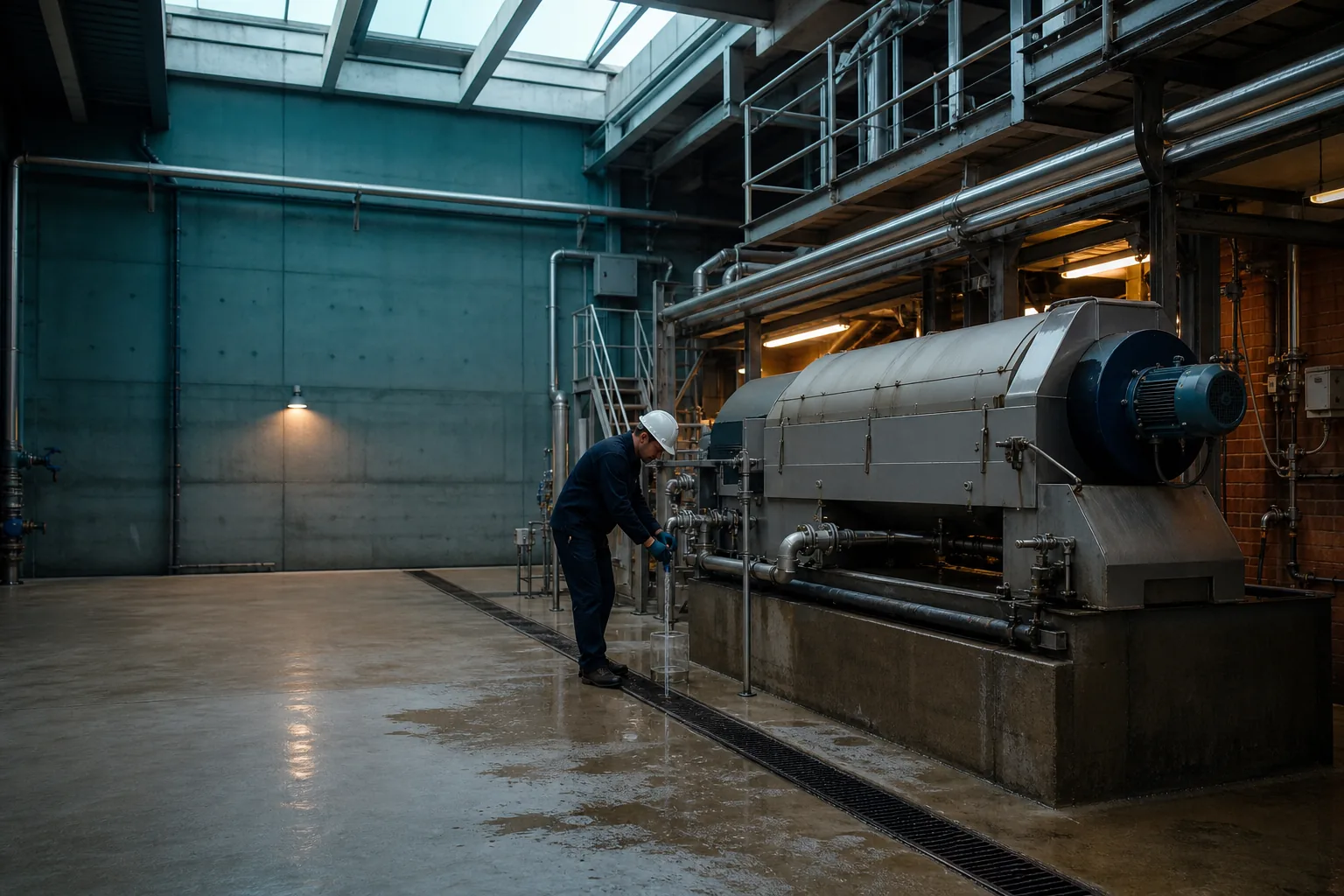
Stabilize the mechanical baseline
Record bowl speed, pond depth, differential speed, torque, sludge flow and feed solids before changing polymer. Mechanical drift can hide a chemistry improvement or create a false one.
Choose a stable feed window and keep upstream sludge blending visible. Sample feed, centrate and cake on aligned time intervals.
Screen before full scale
Use bench conditioning to eliminate clearly unsuitable charge profiles, then take more than one candidate to the centrifuge. Apply representative shear when possible.
Do not rank solely by floc size. A moderate floc that preserves capture in the feed zone may outperform a larger fragile floc.
Build an active-dose curve
Increase active dose in controlled steps and wait for process residence time before sampling. Track centrate suspended solids or capture, cake solids, torque and discharge behavior.
The economic optimum is often a stable region, not a single point. Excess dose can add cost, increase viscosity or change cake handling without a proportional gain.
Tune injection and solution
Check whether injection occurs where the prepared polymer can contact sludge without unnecessary pre-shear. Confirm solution concentration, flow stability and maturation before moving the injection point.
Change one variable at a time. Otherwise the trial cannot show whether improvement came from chemistry, preparation or mechanics.
Preserve the operating envelope
Document the successful grade, active dose, feed range, preparation recipe, injection point and centrifuge settings. Include response to high and low throughput.
Use shear-resilient trial criteria when seasonal sludge or equipment changes require a broader operating window.
Challenge the result with feed variation
After locating a promising condition, test representative changes in sludge solids and throughput rather than ending the trial at one favorable point. Watch whether capture or torque deteriorates before cake solids visibly change.
A product with a slightly lower peak result may be preferable when it holds a wider operating window. Record the point at which operator adjustment is required and the adjustment that restores control.
Run a controlled supplier comparison
Prepare competing products with their product-specific instructions while keeping the active-dose calculation and performance measurements consistent. Randomize or repeat trial points where feed drift is significant.
Allow the machine to reach the new steady state before sampling. Summarize results with feed data and settings so procurement can distinguish product performance from a favorable mechanical condition.
Scale the result into normal operation
A supervised trial may use unusually stable sludge and close technical attention. Before final approval, run the selected condition through ordinary shift changes, normal feed-rate movement and the expected operator control method.
Confirm that storage, preparation capacity and solution-pump range support peak demand without short aging or loss of dilution control. The scale-up is complete only when the chemistry and the plant's operating discipline fit each other.